GST taxpayers will be required to reverse by November 30 the input tax credit (ITC) claimed in the last fiscal in case their suppliers fail to deposit the due tax by September 30, the finance ministry has said. The taxpayers, however, can reclaim the ITC later following the deposit of taxes by the supplier. The ministry has inserted Rule 37A in Central Goods and Services Tax rules to give effect to the new provision.

Larger firms feel that the smaller players have muddied the waters for the IBC process, leading to excessive regulation of resolution Professionals.

Prabhu's maiden Railway budget is high on vision.
Over 100,000 small and medium-sized businesses are non-compliant with e-invoicing norms under the goods and services tax (GST) regime, a mandatory requirement for businesses with an annual turnover of over Rs 5 crore. E-invoicing provides real-time access to invoices that are prepared by the supplier on the purchase of goods, allowing faster accessibility to input tax credit, thereby limiting the manipulation of fake credit as it has to be generated before the transaction. "The default has been reported mainly in businesses with a turnover between Rs 5 crore and Rs 20 crore," a senior official informed

The relationship between the US and India has been very productive, in particular on the trade and technology front, and 2023 can be considered the best year historically for bilateral ties, according to a former top American trade official. Arun Kumar, an Indian-American, who served as the assistant secretary of Commerce for Global Markets and director general of the US and Foreign Commercial Service (USFCS) during the Obama administration, said this during an interview with PTI in Washington. "Looking back on 2023, it was a very productive year for the US-India relationship, by many accounts the best year historically," he said.

Auditors seem to have developed a heightened sense of risk and are not content to tick the boxes and sign the papers.

38 auditors resigned in 2022-23, compared with 46 the previous year.
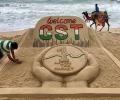
GST collections in March grew 13 per cent to the second highest ever at Rs 1.60 lakh crore, taking the growth rate of revenue mop-up for full 2022-23 fiscal to 22 per cent. March also saw over 91 per cent of the GST registered businesses filing returns and paying taxes - reflecting greater compliance and improving economic activity. Gross GST revenue collected in March 2023 is Rs 1,60,122 crore, of which Central GST is Rs 29,546 crore, State GST is Rs 37,314 crore, Integrated GST is Rs 82,907 crore (including Rs 42,503 crore collected on import of goods) and cess is Rs 10,355 crore, the finance ministry said in a statement.

Customers may lose freebies or have to pay a little more for mobile services in the days ahead as operators try to make up for Rs 61,100 crore they have committed to government in the latest spectrum auction.

A small Ahmedabad-based chartered accountancy firm, whose appointment was questioned by a US short seller in its scathing report against the conglomerate run by billionaire Gautam Adani, has resigned due to "pre-occupation", Adani Total Gas Ltd said. Hindenburg Research in its January 24 report that levelled allegations of fraud, stock manipulation and money laundering against the Adani group, had also raised the issue of the size and capability of the firms auditing the conglomerate. Adani group has repeatedly denied all allegations.

Indian Institute of Technology Madras (IIT Madras) said on Monday that it had raised the highest-ever corpus of annual funds for the institution, garnering Rs 231 crore from alumni, industry and individual donors for 2022-23 (FY23). Its funding increased 76 per cent year-on-year (YoY) compared to Rs 131 crore in FY22, according to data shared by the institute. The number of donors contributing more than Rs 1 crore increased 64 per cent YoY.

With the Indian economy expected to emerge as the third largest by 2030, investors have earmarked significant capital to actively participate in the India growth story.

GST officers can now launch prosecution against offenders in cases where the amount of evasion or misuse of input tax credit is more than Rs 5 crore, the finance ministry has said. However, this monetary threshold will not be applicable in the case of habitual evaders or in cases where arrests have been made at the time of investigation. "One of the important considerations for deciding whether prosecution should be launched is the availability of adequate evidence," the GST investigation wing under the finance ministry said, while issuing instructions for launching prosecution.

...followed by financial services, IT, and sales and marketing.

Packed frozen 'paratha' is not 'roti or chapatti' as it requires further cooking before consumption and despite wheat flour being the 'common thread' there are other ingredients used in making parathas, said an order by the Gujarat Appellate Authority for Advance Ruling. Such parathas, whether named Malabar, Mixed vegetable, Onion, Methi, Alu, Laccha, Mooli or Plain, have ingredients like margarine, salt, emulsifying agent, oil, potato, peas, cauliflower, coriander powder, bread improver and water, apart from wheat flour, which make 'quite different' from plain roti or chapatti and hence are not eligible for 5 per cent Goods and Services Tax (GST) rate, the ruling said. The percentage of wheat flour used by Vadilal Industries, which had approached the AAAR, in the eight varieties of paratha manufactured and supplied by it ranges from 36-62 per cent, whereas the ingredient for plain roti or chapatti is wheat flour apart from water.

The government has notified a host of procedural changes in the GST rules, including levy of interest for wrongful utilisation of ITC and turnover threshold for filing annual returns for the 2021-22 fiscal. The changes were vetted by the Goods and Services Tax (GST) Council at its meeting last week. With the amendments notified by the Central Board of Indirect Taxes and Customs (CBIC), businesses have also been allowed to make tax payments on the GSTN portal by using IMPS and UPI payment modes.
Six years after the rollout of the biggest indirect tax reform in India, Goods and Services Tax (GST) revenue of Rs 1.5 lakh crore every month has become a new normal and tax officers are focusing on dealing with fraudsters who are adopting newer modus operandi to game the system, causing loss to the exchequer. To apprehend black sheep, who operate as syndicates and create fake entities on the basis of forged documents to claim input tax credit (ITC), tax officers have started using data analytics, artifical intelligence and machine learning aiming to curb evasion, which was over Rs 3 lakh crore since inception of GST. It was over Rs 1 lakh crore in 2022-23. Thinktank Global Trade Research Initiative (GTRI) said the most critical pending GST reform is upgradation of GST Network to prevent fake supplies and fraudulent claims of Input Tax Credit (ITC).

Meanwhile, family businesses in India still see banks as their chief source of funding as nine out of 10 respondents were upbeat about bank financing.

The Appellate Authority for Advance Rulings (AAAR) of Gujarat has held that papad fryums would not attract any goods and services tax (GST) as they are similar to traditional round papads in all respects. In this connection, the appellate authority modified the ruling of the authority for advance rulings (AAR), which had ruled that Fryums would attract 18 per cent GST. The AAAR held that Fryums is a brand and not a generic name of the product, Harpreet Singh, partner, indirect taxes at KPMG in India said while explaining the order.

In January, Visa's chief executive officer, Al Kelly, said during an earnings call that "there's been a burst of the balloon in valuations in the fintech world". Noting that the trend of lower valuations "is a helpful characteristic of the current environment", he added: "We will look for capabilities and management teams that will bring more value to Visa than we can bring ourselves." Data from KPMG's Pulse of Fintech H2'22 shows that global fintech investment - via mergers and acquisitions (M&As), private equity (PE) and venture capital (VC) firms - at $164.1 billion in 2022, was down 31 per cent over the year before. Indian fintechs held up better during this timeframe, attracting $6 billion, or a fall of 24 per cent.

Increase in service tax would make properties costlier to buyers.

A 5 per cent GST rate kicked in on Monday on pre-packed and labelled food items such as cereals, pulses and flour weighing less than 25 kg.

Business subsidies may attract tax
The controversy over the goods and services tax (GST) rate on food products refuses to die. Now, the Gujarat-based authority of advance rulings (AAR) has ruled that 'parathas' would attract 18 per cent GST. The applicant, Vadilal Industries, sought to know whether various kinds of 'parathas' supplied by them would attract five per cent GST in line with 'khakhra', plain chapati or 'roti'.

KPMG's global board will meet in India next week

Provisions in the Central GST Act say reduction in GST rates or the benefit of ITC must be passed on to consumers.

Taxability of LPG subsidy and other direct benefits paid directly into bank accounts of beneficiaries is unclear.
Deciding the goods and services tax rate on fryums papad could be a messy affair with the Appellate Authority for Advance Rulings (AAAR) of Gujarat now ruling that the ready-to-eat product would draw 18 per cent rate. In that connection, it slightly modified the ruling of the state-based Authority for Advance Rulings (AAR). The AAR had also ordered that these products would draw 18 per cent GST but under a different classification.

The corporate affairs ministry proposed the names of Borkar & Mazumdar & Co and MM Chitale & Co for IL&FS and IFIN respectively; and GM Kapadia & Co and CNK & Associates for IL&FS Transportation Networks.
.jpg)
Delayed clearances for coal blocks, as well as companies' own failure in developing mines, appear to have had a financial implication of Rs 1.46 lakh crore (Rs 1.46 trillion) for the country.

In 2020-21, Indian firms offered to buy back shares worth Rs 39,295 crore, or 97% more than Rs 19,972 cr proposed in the previous financial year.

With this, India joins 60 other countries that collect PNR details of international passengers.

Aimed at creating a single tax for goods and services across the country, government on Friday introduced the long-pending GST Bill in the Lok Sabha for roll-out of the new regime from April 2016 subsuming various levies like entry tax and octroi.

Fundraising activity in the upcoming financial year 2022-23 may even surpass FY22 when 52 Indian companies raised a record Rs 1.11 trillion via initial public offerings (IPOs). According to a note by PRIME Database, 54 companies (including LIC) plan to raise Rs 1.4 trillion and currently hold the Securities and Exchange Board of India's (Sebi's) approval. Another 43 companies, the note said, are looking to raise about Rs 81,000 crore but waiting for Sebi nod.

Currently, Deloitte, EY and KPMG with their associates work as statutory auditors of most of the top league domestic IT services firms. Owing to many alleged auditing lapses, the regulators have either imposed restrictions on the audit firms or are seeking to do so.

E-way bill generation, which is related to paying Goods and Services Tax (GST) and a key high-frequency indicator of economic activity, may have fallen to a five-month low in April as more cities experience lockdowns due to a surge in Covid-19 cases. In April e-way bill generation may decline to 55-58 million, which is the lowest since at least November. On the higher side, it is a 17 per cent decline over March.

With an epic battle of billionaires for supremacy in one of the world's most prolific markets and a pandemic-propelled surge in online shopping in the background, India's nearly trillion-dollar retail market is hoping to touch 85 per cent of the pre-COVID business in the first half of the New Year. In a year when the COVID-19 carnage ripped apart the retail business, circa 2020 will best go down for the unravelling of the war between Jeff Bezos, the world's wealthiest man, and richest Indian Mukesh Ambani for pre-eminence in the booming market that is estimated to reach $1.3 trillion by 2025. It all started with Ambani's Reliance Industries agreeing in August to buy assets of the nation's second-largest retailer for Rs 24,713 crore, just a year after Bezos' Amazon purchased an indirect stake in the indebted Future Retail.

K R Girish, partner, KPMG India Tax and Regulatory Services, speaking on the Indian Union Budget 2009 at Asia Society in New York.
Arun Kumar, partner-in-charge, KPMG US India Practice, delivering his views on the Indian Union Budget 2009 at Asia Society in New York.

Of the 1,145 offers made this year, consulting firms made up 34 per cent, followed by banking, financial services and insurance, pharma/healthcare, IT/ITeS and FMCG/retail.
 © 2026 Rediff.com - Advertise with us - Disclaimer - Privacy Policy - Sitemap - Feedback - About us - Terms of use - Grievances